
Materiality Assessment
What is a materiality assessment?
A materiality assessment helps a company define and prioritize environmental, social, and governance issues. The assessment is conducted by interviewing stakeholders like workers, customers, suppliers, and members of the community where the company is located. Leaders use the results to align their business strategy with what matters most to their stakeholders.
How did Sunrise Banks conduct a materiality assessment?
We used the UN Sustainable Development Goals and B Corp Impact Topics as our framework to identify and prioritize environmental, social and governance issues relevant to Sunrise Banks . We used the results of this assessment in our B Corp certification, as well as to inform our strategic priorities.
What was our stakeholder engagement process?
We interviewed Sunrise Banks workers, leadership, and customers during our process of developing the matrix. Stakeholders provided qualitative responses about their key environmental, social, and governance topics. Our researchers ranked key topics high, medium, and low priority for each interviewee.
What were the results of the assessment?
We plotted key topics on a grid based on their importance to external stakeholders versus their importance to the business to identify our greatest opportunities. We developed this matrix in 2025, reflecting our priorities at that time, and with an eye to the future.
Sunrise Banks 2025 Materiality Assessment Matrix
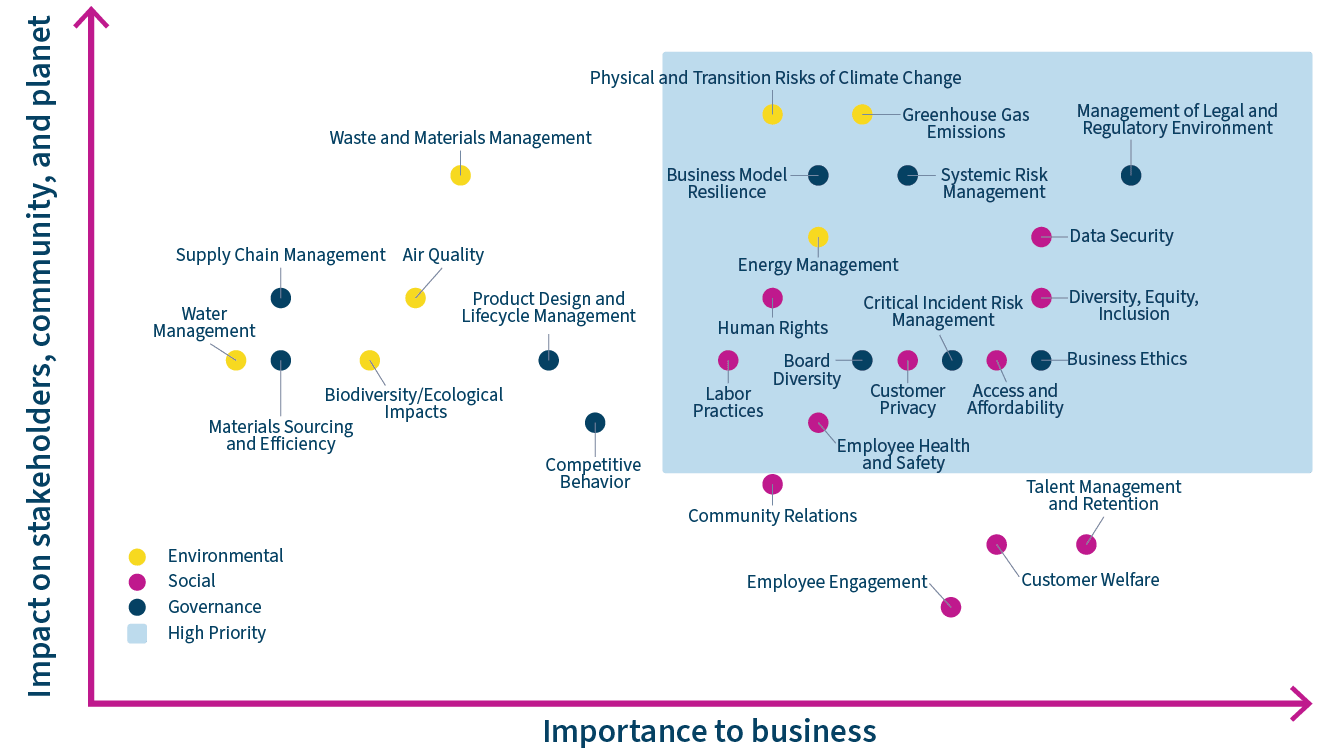
Below is the list of topics that are addressed in the materiality matrix. Bolded topics are of the most importance to shareholders and to the business.
-
Environmental
- Greenhouse gas emissions
- Physical and transition risks of climate change
- Energy management
- Waste and materials management
- Air quality
- Biodiversity/ecological impacts
- Water management
-
Social
- Data security
- Diversity, equity, inclusion
- Energy management
- Access and affordability
- Customer privacy
- Labor practices
- Employee health and safety
- Community relations
- Customer welfare
- Talent management and retention
- Employee engagement
-
Governance
- Management of legal and regulatory environments
- Systemic risk management
- Business model resilience
- Business ethics
- Critical incident risk management
- Board diversity
- Supply chain management
- Materials sourcing and efficiency
- Product design and lifecycle management
- Competitive behavior
What comes next?
This matrix, which will be reassessed and updated at least once every three years, will help to guide our company strategy and product development. Through this process we will be able to confirm that our company vision is continually being realized.
Read more about how we’re addressing these material issues in our Impact Report.
Digital Banking Log In
Securely log in to digital banking to manage your accounts, send payments, transfer money and pay bills.